Amazing Use of Space!

Watch as this 344 square foot Hong Kong apartment transforms into 24 rooms! Think outside the box. What can you add to your space?

Saving Water, the Water Pebble

Dry Planet

It’s April, “Earth Day Month”. For me, that creates even more awareness everyday that we need to be taking steps to preserve and protect our planet, our real estate.

My big passion is water. I’ve written a number of posts about it. Here, again, is a wonderful site devoted to the preservation and protection of water.

This article focuses on something new and so easy to use, the Water Pebble.  This device simply sits near any water drain and times the water usage.  It “teaches” you to reduce the time you have the water flowing.  Waterpebble could help reduce the average shower to less than 6 minutes saving over 20 litres of hot water every time.

At this time, I’m not planning to buy a water pebble but, because of reading this, I am going to be more aware of the time I spend in the shower, rinsing dishes, washing my hands, any time I run water.

Isn’t it great to be aware?  We hold so much power in our own decisions, our own actions.  What will you do to make a difference to the Planet?

“When the Well’s dry, we know the Worth of Water.”
Benjamin Franklin (1706-1790), Poor Richard´s Almanac

Winston Salem’s Hanesbrands recognized for green programs!

Hanesbrands

Congratulations to our very on Winston Salem Hanesbrands for being green.

Hanesbrands has been named the Energy Star 2010 Partner Agency of the Year by the U.S. Environmental Protection Agency in recognition of its energy conservation programs.

Beyond that, Hanesbrands announced new goals to increase it’s use of renewable energy and reduce its emissions.

I’m impressed that Hanesbrands has been tracking its carbon footprint since 2007.  Goals for reductions in energy use, carbon emissions and water use by 2012 are to:

Read more…

Building Permits – do you need one?

Building Permits

Building? Renovating? Do you need a permit? How do you find out? Where do you go? What does it cost?
Here are a few of the facts for the state of North Carolina at this time. Updates happen in every industry. Do what you can to keep current and be sure to check with your state if you live outside NC.

The basics: if you intend to do over $30,000 in repairs, anyone can go to the city and get a “privilege license”. You are then a licensed contractor. Beware of people who show up to work on your home claiming to be licensed. All you need to do is go to the city and request a privilege license. Make sure your contractors are for real.

If you plan to do less than $5000 in repairs and it is not structural, you do not need a license. However, you may want to find out what is meant by “structural”. If,for example, you need to repair a single pillar under the house, that is structural. If you’re having a roof replaced and the boards also need replacing, that is structural. If the repair is structural, no matter the cost, you must have a permit.

Read more…

Build a House for $8.33 per square foot

Cobb House

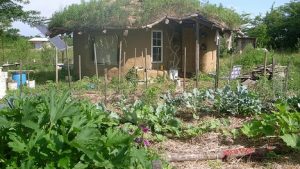
“You can build your own cob house with little money, but with lots of time and enthusiasm,” according to Kent at Tiny House Blog.   This is Ziggy’s cob (a mixture of straw, clay, and sand similar to adobe) with a footprint of 360 square feet built for under three thousand bucks. (Yes, that is $ 8.33 per square foot.)

Here’s what you need:

* sand (just over 30 tons total) – $507
* gravel (about 13 tons total) – $177
* straw (16 bales) – $36 (most straw I used was free)
* black walnut scrap lumber – $100
* misc. lumber – $20
* windows – $220 (two casement, one double hung window)
* electrical – $28
* galvanized wire – $30
* nails – $100 (I couldn’t believe how expensive nails are)
* raw linseed oil (for floor) – $72
* EPDM pond liner $622
* polycarbonate for skylight $400

Oh, yeah, and 9 months of full-time labor!

Cob interior

Read more about it at The Year of Mud:  Building a Cobb House.

Green Walls by Nature!

Green Walls

Green roofs have beautifully proven themselves to be a resource against global warming. There is one problem with the green roof in all its beauty and function… very few people can see it!

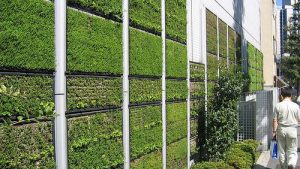
Green walls, however, allow us to raise living plants in a whole new way while providing some physical advantages. For one thing, what a wonderful position as a gardener to work standing up!

For the most part, the needs of the plants will be the same as if they were planted in any horizontal plane. More good news, weed seeds have a harder time rooting on a vertical plane.

Check out these green walls! Once again, they challenge us to think outside our own box. I love that!

Starbucks makes a lot of efforts to be “Green”. They are considered one of the most socially and environmentally responsible companies in the world. Now, at many stores, they’re sprucing up their drive-throughs with green features.

Green Walls - Starbucks

Green walls can be used indoors.
Indoor Landscaping

Green walls are found most often in urban environments where the plants reduce overall building temperatures which helps reduce energy consumption. Living walls are especially suitable for crowded cities as they allow good use of available vertical surface areas.

Oulu

How about this amazing building by Korean architect Minsuk Cho! It is the Ann Demeulemeester Shop in the Gangham district of Seoul.

Shop in Seoul

I hope these photos have inspired you like they have me! Another wonderful way to grow gardens! I, for sure, am going to try one.

Imagine raising an edible crop wall. For starters, I think I’ll try growing wheat grass. My husband loves energy shots of wheat grass from Jamba Juice. Wheat grass shots are pretty expensive so now I can try to grow my own. I’ve heard they’re pretty easy; don’t know about on the wall!

Greenwalls - wheatgrass

Whatever you try, good luck and let me know how it turns out!

Green Roofing Systems

Green Roof by Convert

Have you heard about Green Roofs? Check out the wonderful site for Convert.

“Convert is dedicated to implementing green roofs as sustainable strategies for storm water BMPs, energy efficiency, and urban heat island mitigation.”

What a wonderful way to go green!

What defines “Building Green”?

Building Green

I own a beautiful lot in the mountains of North Carolina, the Appalachian Mountains. If you want to sit and appreciate one spectacular wonder of Earth, visit the Appalachian Mountains.

My goal for 2010 is to build a home there and I plan to Build Green. In beginning my research, I’ve found that there’s no end to the research! So, I’ve started by asking what exactly is “Green”? What makes a product Green? How do you evaluate product Greenness? Can you make a product Greener? And, how do I find Green products?

Read more…

Don’t Buy Organic Produce

Don't Buy Organic

Really??? Well, organic should be your first choice when it’s locally grown, but consider that shipping a pound of organic apples across the country increases fuel and greenhouse gas emissions by 30 percent – more than if they had been consumed at their point of harvest. And much of the organic produce on the market is now shipped across the planet. Meanwhile, many local farmers practice organic methods but don’t certify organic because it is expensive and labor-intensive administratively. Since each type of crop needs to be registered, for a smaller farm growing a variety of food it becomes a Herculean task. If you shop at a farmer’s market, talk to your vendors and see if they use eco-friendly agricultural methods–many of them do because they recognize the importance of keeping their land healthy. Consider buying non-organic locally grown produce over non-local organic produce, if you can determine that it was grown conscientiously.

Thanks for this article by Melissa Breyer and her 7 Tips for Green Eating posted at Care 2 Make a Difference

Building Green

Green Building

I was reading an article today and it made me think differently (I love when that happens) about green building.

We hear often that building green is much more costly than traditional building, the main reason more people don’t do it. Have you ever stopped to really question why? Lloyd Alter wrote an article I found on TreeHugger discussing this very topic.

First, we build homes the traditional way, then we add on energy efficient technology which, of course, adds to the cost of the home. The problem is, we continue to build homes the way we always have then we modify them, alter them, add onto them, all in an attempt to make them efficient. So, we pay to build the house then pay again to in our efforts to make it efficient. As the house gets greener, the cost keeps going up.

We need to expand our thinking. Determine how do we build an efficient house? The traditional way doesn’t do it. We need to rethink and redesign architecture as we’ve known it. Rather than putting on a roof and adding solar panels, how do you redesign roof systems? Look at the tankless water heater. Water heater redesign. No more water!

Rather than building a house then rebuilding it to make it efficient, we have to redesign ground up! What does efficiency look like?