
What Credit Score do You Need to Get a Loan?

Credit Crunch

When applying for credit, one of the first things you need to know is your credit score.

But why?

Your credit score will greatly impact, not only your ability to get a loan, but how much interest you will pay if you do. The higher your credit score, the lower your interest rate and, therefore, the lower your monthly payment and ultimate price of the house over time.

What credit score gives you the best chance of getting a loan?

Read more…

Additions to Borrower’s Credit Score

Mortgage lenders will soon have access to additional details about a prospective borrower’s past. These items will be factored into a new credit score and will, hopefully, help lenders make more informed lending decisions.

CoreLogic will serve as a “supplemental credit repository,” providing additional data not provided by TransUnion, Equifax and Experian. This data will include property ownership and mortgage obligation records, property legal filings and tax payment status, rental applications and evictions, inquiries and charge-offs from pay-day and online lenders and consumer-specific bankruptcies, liens, judgments and child support obligations.

Read more…

Cost of Closing a Credit Card

Credit Score Close a card Miss a payment Max out your cards
680 40 70 95
720 55 80 115

Does closing a no balance credit card effect your credit score? Chances are, yes.

One of the factors that goes into evaluating your credit score is how much available cash or credit you have versus how much debt you owe. If you have a credit card with a $5000 available balance, once you close it, you have $5000 less available which increases your percentage of debt.

On the other hand, maxing out your credit has an even worse credit score consequence so, if you know you’ll end up spending that available amount, you’re better off with fewer cards.

The above chart shows the approximate point loss if you close a card, miss a payment, or max out your cards.

As you can see, you actually lose more points if your credit score is higher.

What are you doing to protect your credit?

Repairing Your Credit

credit card cash

Do you realize how important your credit score is, all the time?

Who looks at your credit score? Everyone!

  • Insurance companies. If you’re a high risk based on your credit score, you’re a high risk for insurance companies and they’ll charge you a higher rate.
  • Employers. What’s the risk if they hire you?
  • Landlords. If you apply for a rental property, what risk do landlords take with you? Want to know what a landlord will see about you? Check out SimpleScreening.
  • Mortgage Companies. If you apply for a home mortgage, credit score not only affects whether or not you get a home loan, but what interest rate you will pay if you do.  A credit score plays a large role in a lender’s decision to extend credit and under what terms. For example, borrowers with a credit score under 600 will be unable to receive a prime mortgage.
  • Credit Card Companies.  They check your credit score to determine, not only if you get a credit card, but what interest rate you pay if you do.

The higher your credit score, the less you will pay for all the above.

Repairing Your Credit and Keeping it There: Read more…

Filing Bankruptcy cannot stop you from Investing in Real Estate

Guest Post

Bankruptcy filing is a severe setback to your financial condition. For those who are inclined toward real estate investment, you may think that this is the end of your investment dreams because you are no longer in the good books of your lenders and cannot expect further loans for investment.

These concerns are justified, but the scenario may be different than you think. Chapter 7 bankruptcy laws state that, although bankruptcy filing destroys your credit report, you still stand a chance to get loans for future investments. Wondering how?

The first thing you need to do is gain positive credit which is not readily available after filing bankruptcy. There are, however, good ways to build quick credit and you can utilize these to invest in your real estate business.

Here are some steps to restructure your financial state:

Read more…

Caution: Your credit score may sink when you sign up for mortgage relief

Credit Drop

According to the Washington Associated Press,  if you sign up for the government’s mortgage assistance programs, there’s a chance you may get something  you don’t expect – a lower credit score.

What are these mortgage assistance programs?
  • Home Affordable Refinance: This option can help you refinance into a more affordable mortgage if you’re paying your mortgage on time but you’re unable to refinance to a lower rate because you owe more on your mortgage than your home is currently worth.
  • Home Affordable Modification: This option can help you get mortgage payments you can afford if you’re delinquent in making your monthly mortgage payments, in the foreclosure process, or current on your payments but have recently experienced hardship and you are about to miss a payment.

There are many pitfalls showing up with these programs.  One very important one is this, if you are struggling to continue making your payments on time so you sign up for a government loan modification program,your credit score could immediately reduce by as much as 100 points!    What?  Why?

Read more…

Mortgage Resets – Here comes the next wave

Mortgage Resets

I know everyone really wants to believe the housing market is going to get better in 2010. I know we’ve all had enough of the gloom and doom, but it appears we have to brace ourselves for more of the same, at best.

We’re so used to turning the channel when we get bored with what’s on. We expect to drive up to the window and have our food ready. We swallow a pill in anticipation of instant headache relief.

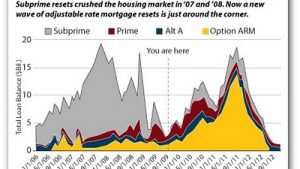
But, from the looks of this graph, we’re going to be in this one for a while.

From the graph, you can see the first wave that’s already passed, the grey wave.  It peaked mid ’07 then again in January ’09.  Those were the sub-prime loans resetting that put us into the tailspin we’re just now trying to come out of.

The next, and far more layered wave is just beginning to form.  You can see the dotted line where it began in January 2010.  It is 4 layers deep – the grey sub-primes, the red prime loans, the blue Alt A’s and the yellow Option Arms.  Everything peaks mid year 2011.

Add to that all the “shadow inventory” the banks have taken back and are still holding that some people say is more than they’ve already released.  Hang on, boys and girls, it’s going to be a bumpy ride.

It’s better to know ahead of time to be prepared. Stop spending. Save what you can, when you can. Scale back, downsize, reuse, recycle.

The real estate market will come back strong. It always does. We’ll just have to be patient a while longer.

So, what’s the good news?  There’s never been a better time to invest in real estate.

If you live in the Triad area of North Carolina, we’d love to help you with your investing.  Check out our Triad Master Mind. It’s a great group of local investors and we’re all working together to help each other profit through real estate.

Don’t wait to invest, invest and wait!  Huge returns will be there to reap in your future.

Happy investing!

How do you Protect What you Have?

Lock by AMagill.photo by AMagill

With the implosion of the housing market, the collapse of credit, and the unpredictable ups and downs of Wall Street, how do you protect what you have?

If you listen to the news, you’ve heard that trillions of dollars have been lost in savings this year alone, 7.6 million people are newly unemployed, and there is a record high in home foreclosures & bankruptcies with more to come.  Add to that the fact that, according to the Consumers Union, 8.3 million + Americans have their identities stolen each year .

The news is worrisome at best, the outlook bleak for the near future.  But, don’t paralyze.  Get busy informing yourself and protecting what you have and what you plan to accumulate in the upcoming years.  You may not know enough now but, by this time next year, let’s all vow to be better informed.

Should you handle your finances on your own?

To begin with, know your rights and study your investments.   The ones you trust your money to should know what they’re doing.   Do they?   Ultimately, you are the one who is responsible for your own success.

What are some pro-active things you can do?

Read more…

Turned Down for a Mortgage? What’s Next?

First of all, you’re not alone. Hope that helps… According to the Mortgage Bankers Association in Washington, D.C., about half of all mortgage applicants are now being turned down. Half. Good grief, that’s a lot.

Did you receive a formal rejection spelling out the reasons you were turned down? If you were turned down because of information on your credit report, federal law entitles you to something called an “adverse action” notice.

According to the Federal Trade Commission, when credit is the issue, you’re entitled to a copy of the results showing the reason for the negative report from the credit reporting agency that provided the data on which the lender based its decision.  Whew!   You’re also entitled to a free credit report; see the FTC web site for more information.

You’ll want to know the reason for the rejection so you can fix what’s wrong, if anything is, and make sure you clear it up.  You also want to make sure that the reason is valid and not a mistake on your credit report.

Read more…

Debit Card – do you use one?

Debit card
photo from TalkforFinance

We’ve talked about credit cards in New Credit Card Laws go into Effect August, 2009, and Your Credit Card is Canceled.

But we haven’t talked about Debit Cards.  Do you use one?  Do you know the danger if you do?

For example, if you use the card and don’t have enough money in your checking account to cover the charge, you can be fined up to $39 every single time you exceed your balance.

May not sound like much but, if you’re out shopping and charge 5 or more times, it adds up!

And, many banks don’t debit your account in transactional order.  What I mean is, you could have $400 in your account and make several $20 purchases.  Later in the day, if you charge $350, you’re over for the day.  You would think that the three $20 purchases would not incur a fine, but, if the bank takes out your last charge first, you’ll pay a fee for every purchase made that day.

Read more…