Wells Fargo Converts Option ARM’s to Interest Only

Wells Fargo

What is an Option ARM mortgage?

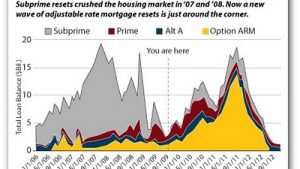
With an Option ARM, your monthly payment includes no principle payment and is actually less than the minimum amount of interest due. The difference in interest is then added to the outstanding loan balance, causing the overall loan balance to increase.

Repeat:  with this type of payment, each month your principal, or balance due, actually goes up.

Why would someone get this type of loan? Because the payments are low.  Artificially low.  But  paying the minimum payment each month is simply a way of deferring the interest, not avoiding it altogether.  Option ARMS are responsible for many borrowers now owning homes worth less than the mortgage debt.

Read more…

Reverse Mortgage – Good Thing or Bad?

Reverse Mortgage

Like most things, it depends…

A reverse mortgage provides income for people to tap into for their retirement.

One advantage of a reverse mortgage is that the borrower’s credit is not relevant because the borrower does not need to make payments. The home serves as collateral and must be sold to repay the mortgage when the borrower dies (in some cases, the heirs have the option of repaying the mortgage without selling the home).

One disadvantage is that these types of mortgages have large origination costs relative to other types of mortgages. The costs become part of the loan balance and accrue interest.

No repayment of the mortgage (principal or interest) is required until the borrower dies or the home is sold. After accounting for the initial mortgage amount, the rate at which interest accrues, the length of the loan and rate of home price appreciation, the transaction is structured so that the loan amount will not exceed the value of the home over the life of the loan.

Read more…

$8000 Tax Credit Extension?

HUD Secretary Shaun Donovan
Housing and Urban Development Secretary Shaun Donovan testifies on Capitol Hill in Washington, Tuesday, Oct. 20,2009, before the Senate Banking Committee hearing on the housing market.(AP Photo/Harry Hamburg)

As of Tuesday, October 20, 2009, Shaun Donovan, Secretary of the Department of Housing and Urban Development, told the Senate Banking Committee that the White House hadn’t make a decision on extending the tax credit and was looking at the costs.

Uh, oh. And, guess what? They don’t know what the costs have been so far. Why? Eligible refunds show up on tax returns. Tax filing season doesn’t start until next year. But Donovan said he expects to get cost data in the next few weeks. “We understand the urgency of this situation,” he said.

Guestimates at this time are that it would cost about $1 billion a month to extend the existing credit. This is according to congressional estimates. Cost for a bill to extend the credit to June 30, 2010, is estimated at $16.7 billion. So the government, what, prints more money?

Read more…

USDA Offers 100% Financing

USDA House

We recently bought a home, renovated it and put it back on the market all within a month.  Just 12 days after listing it, we accepted an offer.  Why so quickly in this “difficult to sell” market?  One reason may be that we were able to advertise it as qualified for USDA financing.  What is USDA financing?

The United States Department of Agriculture offers home loans funded directly by the Government for certain properties.  These loans are available for very low and low-income households.  Qualified buyers are entitled to 100% financing for their purchase.

In order to be eligible for most USDA loans, households must meet certain income guidelines. Also, the home to be purchased must be located in an eligible rural area as defined by the USDA.

These USDA loans, Section 502 loans, are primarily used to help low-income individuals or households purchase homes in rural areas.  Funds can be used to purchase an existing dwelling, purchase a site and construct a dwelling, or to purchase newly constructed dwellings located in rural areas. Mortgage payments are based on the household’s adjusted income.

There are other requirements such as:

  • Acceptable credit history
  • U.S. citizen or qualified resident alien
  • Owner-occupant
  • Additional lender requirements

but with the possibility of 100% financing, shouldn’t you find out if a USDA program will work for you?

Have 2 Mortgages & Need to Refinance?

Mortgage Refinance

It may be harder than you think.

Some banks are refusing to refinance mortgages because they want borrowers to pay off loans and clear up shaky bank balance sheets. Today, you may be rejected no matter what your qualifications.

What you can do to help the process?

  • Determine an accurate value of your home. True value drives the refinancing process.
  • Go to Making Home Affordable to find out if your loan is owned by Fannie Mae or Freddie Mac. If they own your first loan, that works in your favor.
  • Protect your credit score. Make all payments on-time. Get your balances down. You know the drill. Poor credit makes the process even more difficult.

The Obama administration is on your side. New policies encourage banks to be flexible and support the new programs that are designed to aid you and the housing industry. However, the banks are still needing to remove debt from their balance sheets so many of them are still not as flexible as you may need.

There are statistics showing as much as a 40% decrease in refinancing approvals for people who should be able to refinance. Most banks have money to lend, but they’re not.

Read more…

Owner Financed Homes Qualify for $8000 Tax Credit

$8000 tax credit

There’s a lot of action going on with the $8000 tax credit and we’re getting lots of questions concerning whether or not our Agreement for Deed qualifies.

“Yes”, is the answer! We close with an attorney and submit a HUD-1 with the buyer’s tax return so the return can be amended.

The following comes from the IRS web site:

Q. Can a taxpayer claim the first-time homebuyer credit if the purchase is pursuant to a seller financing arrangement (for example; a contract for deed, agreement for deed, installment land sale contract, or long-term land contract), and the seller retains legal title to secure the taxpayer’s payment obligations?

A. If the taxpayer obtains the “benefits and burdens” of ownership of a residence in a seller financing arrangement, then the taxpayer can claim the credit even though the seller retains legal title. Factors that indicate that a taxpayer has the benefits and burdens of ownership include: 1. the right of possession, 2. the right to obtain legal title upon full payment of the purchase price, 3. the right to construct improvements, 4. the obligation to pay property taxes, 5. the risk of loss, 6. the responsibility to insure the property and 7. the duty to maintain the property. (New 7/2/09)

So, if you’re in a lease-to-own situation, you may be able to give the owner a nice downpayment that enables them to owner-finance and qualify you immediately for the $8000 tax credit.

*Start owning today!

Mortgage Forgiveness Debt Relief Act

Mortgage Forgiveness Debt Relief

The Mortgage Forgiveness Debt Relief Act became law December 20, 2007.

This law states that you should not receive a 1099 form for the debt forgiven for a loan secured by a qualified principal residence. So, if a you sold your home for less than the mortgage amount and the lender forgave the remaining debt, you no longer have to list that amount as taxable income.

Normally in US law, when a lender decides to forgive all or a portion of a borrower’s debt and accept less, the forgiven amount is considered income for the borrower and may be taxed.

However, since the Mortgage Forgiveness Act, amendments have been made to remove such tax liability and allow the borrower and lender to work together to find a solution that is beneficial to both parties. This protection is limited to principal residences — rental properties are ineligible for relief — so ask you tax advisor to be sure you qualify.

Read more…

Raising Your Credit Score after a Short Sale

Credit Report

How does a short sale affect your credit report and is there anything you can do about it?

It depends on how the bank reports it to the credit reporting agencies and.. they have lots of options. Sometimes, if you’re lucky, they don’t report it at all. Or, it could even show up as a foreclosure.

They can also report it as settled. This usually happens when an agreement has been reached between the lender and the borrower to repay only a portion of the original debt. This does hurt your credit but not as much as multiple delinquencies, a charge-off, a foreclosure or a bankruptcy. (A charge-off is when the lender transfers non-collectibles to a category such as bad debt or loss.)

If you do have a short sale with your lender, request that they report it as unrated. The beauty of unrated is that it is neither credit-positive nor credit-negative.

And it is possible for the lender, as a condition of the short sale, to remove any derogatory reporting that has already taken place! The lender may tell you that they don’t have the ability to do this, but they do and they can.

Write to your lender and demand that one of these scenarios be a condition for your short sale. If they don’t respond to you and the short sale is completed, you can then challenge any derogatory credit reporting that occurs and may be able to get it removed based on your letter.

As you can see, there are options if you’re facing foreclosure or a short sale and want to protect your credit status. The situation may not end up as bad as you think.

Any other ideas or experiences with credit and short sales?

New Credit Card Laws go into Effect August, 2009

Credit Cards

On May 22, 2009, President Obama signed the Credit Card Accountability,Responsibility, and Disclosure (CARD) Act of 2009. “Just as we demand credit card users to act responsibly, we demand that credit card companies act responsibly too,” he said before signing the Act. Do you know what it says and what it means for you?

The purpose of the bill is to amend the Consumer Credit Protection Act, to ban abusive credit practices, enhance consumer disclosures, and protect under age consumers among other things.

Several new rules to curb some of the worst industry practices go into effect this month, August 20th. Most of the provisions kick in next year. The requirements under the CARD Act become effective in 3 stages.

What are some of the requirements?

Read more…

The Housing Crisis is Nowhere Near a Bottom

Houses

I read this interesting blog post by Felix Santiago about What Lenders Won’t Tell You About Your Short Sale.  It’s a very interesting article.  Here are some highlights:

3) Lenders and investors make secret deals for billions of dollars every day behind your back! Many agents  want to see and believe that their real estate transaction is the only way the lender can move the property.   In fact, this is by no means the principal manner of unloading their inventory.  REO’s along with performing and non-performing notes account for the majority of their swaps.  However, those sales are never recorded in public records.  Most of them are sold for pennies on the dollar.

4) The housing crisis is NOWHERE NEAR A BOTTOM! The biggest reason for this is the tremendous amount of inventory.   I’m not simply talking about the inventory in the lender’s hands.   I’m talking about inventory yet to be taken back.   There are millions of homeowners living in their homes for free.   I  have clients going on 2 and 3 years without a mortgage payment.  The lenders and their investors are simply overwhelmed by this crisis and they would rather see someone in the property taking care of it.  Once they foreclose, they are responsible for all the bills on the house.  Only 30% of the lender inventory is even available for sale.  Nearly three times the current inventory is pending foreclosure. And unless everyone behind on their payments gets back to work and starts paying their mortgage, the crisis will not be going away any time soon.

Check out his entire article on Felix’s Blog and let me know here what you think about it.